

Editor’s note: This blog was written by One Fish Foundation Intern Kiran Johnson. The 2026 Green Crab Summit and Green Crab Week in Portland, ME were a full-on immersion for her into the world of local seafood advocacy and collaboration.
By Kiran Johnson
In 2020, invasive green crabs arrived on Haida Gwaii, an archipelago with two main islands located off of British Columbia, Canada.
From then on, the green crab population exploded, said Elijah Gladstone. He is a harvester, founder of ecological monitoring company Haida Gwaii Marine Solutions, and part of the Council of the Haida Nation, the indigenous council of Haida Gwaii.
“We have a traditional sockeye salmon fishery,” he said. “And we were starting to see green crabs actually crawling up the net and eating the eyes out of our salmon. And so we would have to check the nets way more often so that green crabs didn’t eat our harvest.”
On June 24th, Gladstone and Linden McDiarmid, who also works at Haida Gwaii Marine Solutions, presented this issue at the Green Crab Working Summit, in Portland, Maine. They sought to learn from the East Coast, where green crabs have existed since the 1800s. Here, the crab has aggressively scavenged shorelines, destroying eelgrass, eroding mudflat habitats and devastating native bivalve populations such as soft shell clams, mussels and oysters. Green crabs are widely thought of as pests, but the summit centered on shifting this perception of them into an abundant resource that can be used… as food.
Linden McDiarmid and Eli Gladstone of Haida Gwaii discuss the trapping program they’ve run for the past several years.
“This was an opportunity for cross-industry collaboration,” said Mary Parks, founder of GreenCrab.org. The non-profit is one of the summit’s organizers, along with Manomet Conservation Sciences, Eating with the Ecosystem and New Hampshire Sea Grant.
Cambodian, Vietnamese and Italian communities in the U.S. have cooked with green crab for generations. However, using cuisine as a means of population control for an invasive species predicted to become more abundant with climate change is newer. This strategy’s success relies less on any single recipe than on strong relationships built between the harvesters, chefs, researchers and advocates gathered at the summit.
Building relationships
The chef-harvester connection between David Standridge and fisherman Jason Jarvis illustrates this. Standridge was one of several chefs at the summit doing a cooking demonstration using green crab. He stood in front of a small audience, sautéing onions, herbs and tomatoes, which he combined in a large pot with the crab to make a fragrant stock.
Standridge said he grew curious about cooking with the invasive species around two decades ago but struggled to find culinary-grade catch, as green crabs were — and still are — mostly used for bait. He opened his restaurant, The Shipwright’s Daughter, in 2020, serving sustainably-sourced New England seafood in Mystic, Connecticut. In 2021, he connected with Jarvis (who fishes out of Westerly, Rhode Island), who agreed to add green crab to his catch list. Since then, Standridge has processed over 10,000 pounds of the invasive crab sourced from Jarvis.
Jarvis is co-founder of Quonnie Fish Co., a fishermen-owned cooperative selling cooking-grade underutilized and invasive species directly to chefs and consumers. He and Standridge share a local approach to seafood and a willingness to adapt to each other’s practices.
“I do think something that’s so special about David and Jason’s relationship is David’s willingness to drive to Jason to pick up the crabs,” said Parks. The summit aimed to build more relationships with this type of mutual understanding.
Helping harvesters
While the green crab fishery has a low barrier to entry – due to the minimal equipment required to trap them and the often affordable licensing in some states – harvesters face numerous challenges. These include uncertain catch volume in this wild fishery, variable pricing, safe storage, transportation, and processing in order to provide culinary-grade product.
During a harvesters lunch, eleven folks who catch green crabs from around New England, plus Gladstone and McDiarmid, connected over pizza. They discussed strategies and difficulties they had faced in catching and handling green crab.
“Exchanging practical and technical skills is crucial,” said Parks. “So many people working with green crab have shared experiences.” All attending harvesters received an honorarium worth a day’s work for their time at the summit.
Creating a regional network for knowledge-sharing is key to provide the tools and support that harvesters need in order to meet rising demand for green crab. And it’s an essential part of growing the green crab fishery.
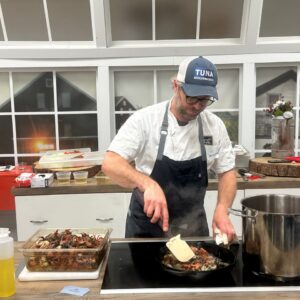
Chef David Standridge of The Shipwright’s Daughter demonstrates how to reduce cut green crabs to make a broth for stock during the summit. Photo: Kiran Johnson
“Chefs get to influence both sides of the conversation,” said Standridge—providers on one end, consumers on the other, with chefs positioned to shape both.
This influence matters because the economics are still difficult for many harvesters to justify spending their time to catch green crab. Harvesters need at least $0.70 per pound to break even, with $1.00 per pound cited as the preferred price to make the effort worthwhile. The bait market – historically green crab’s largest volume buyer – pays $0.40 to $0.60 per pound, which is below that threshold. The result is a fishery that survives on volume caught, not value, leaving little room for profit and deterring many fishermen.
The culinary market offers a way out. Soft-shell green crab can sell for $1.50 to $3.50 per crab, and value-added products push the price even higher. At the summit, there were samples of such products: salted green crab from Khmer Maine, a four-course fermented fish-sauce (including green crab and eel garum) tasting by Maine Garum Co., and crab broth from St Ours and Co. The invasive crustacean had also been turned into bourbon by Tamworth Distilling and vodka by Bold Coast Spirits.
The pitch
Increasing the number of green crab products creates more places for harvesters to sell their catch. These high-value products have also made green crab more accessible. Chefs and consumers can use the crab’s flavor without having to process the crustacean themselves and are able to buy green crab products in grocery stores or online.
This growing awareness contributed to 58 restaurants and fish markets participating in this year’s Green Crab Week, a community-focused event celebrating green crabs as culinary fare, culminating in the Green Crab Working Summit. Parks usually invites all participating restaurants, but this year, many restaurants featured the species on their menus of their own accord.
“As chefs, we have a rare opportunity to promote green crab at our restaurants,” said chef Jordan Rubin, who runs three restaurants in Portland with his partner Marissa Rubin: Ladyfish, Crispy Gai and Mr. Tuna. The latter began as a food truck nine years ago, serving sushi with ingredients sustainably sourced from the Gulf of Maine.
“Crab has always been a pretty easy sell,” he added. Rubin began working with green crab in 2022, serving it at Mr. Tuna. At the summit, he helped chef Christine Lau of Ladyfish with a cooking demonstration.
She fried buttermilk-battered softshell green crab, while Rubin prepared buns with dollops of cilantro jalapeno sauce for the cooked crab. Lau had tried green crab for the first time the day before the summit. She had been impressed.
Many chefs pointed to the crab’s sweet, delicate flavor as an easy pitch, alongside the argument that eating it helps curb an invasive species.
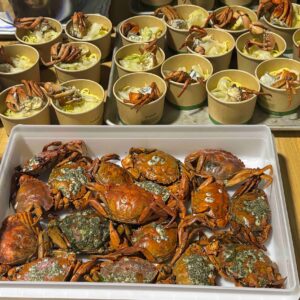
Among the featured tasty samples were Green Crab Ramen with St. Ours’ Green Crab Broth and Roasted Cabbage with Green Crab Garum from Maine Garum Company.
McDiarmid explained that on Haida Gwaii, people tend to view green crab as something toxic, rather than a useful resource.
Both McDiarmid and Gladstone have been trapping and counting green crabs as part of a five-year program run by The Council of the Haida Nation in partnership with Fisheries and Oceans Canada, The Government of British Columbia and Marine Plan Partnership for the North Pacific Coast. The program, which recently ended, was aimed at researching and depleting the population and received funding for five years.
“I think we need to kind of shift and realize that these green crabs aren’t going anywhere,” said Gladstone.
Looking to New England, Gladstone thinks incorporating green crab into cuisine might be a way to continue trapping the invasive species. He wants to create the markets for green crab that New England has, and now, he has industry relationships to draw on to build those markets.

Kiran Johnson is a recent graduate of Northeastern University and has a passion for storytelling (she majored in journalism) and local food systems. She’s done some cool work interviewing Massachusetts lobstermen about life on the water and challenges they face through a program from Woods Hole Institute. She recently supported One Fish Foundation’s participation in the Seafood Throwdown at Boston Jerkfest.
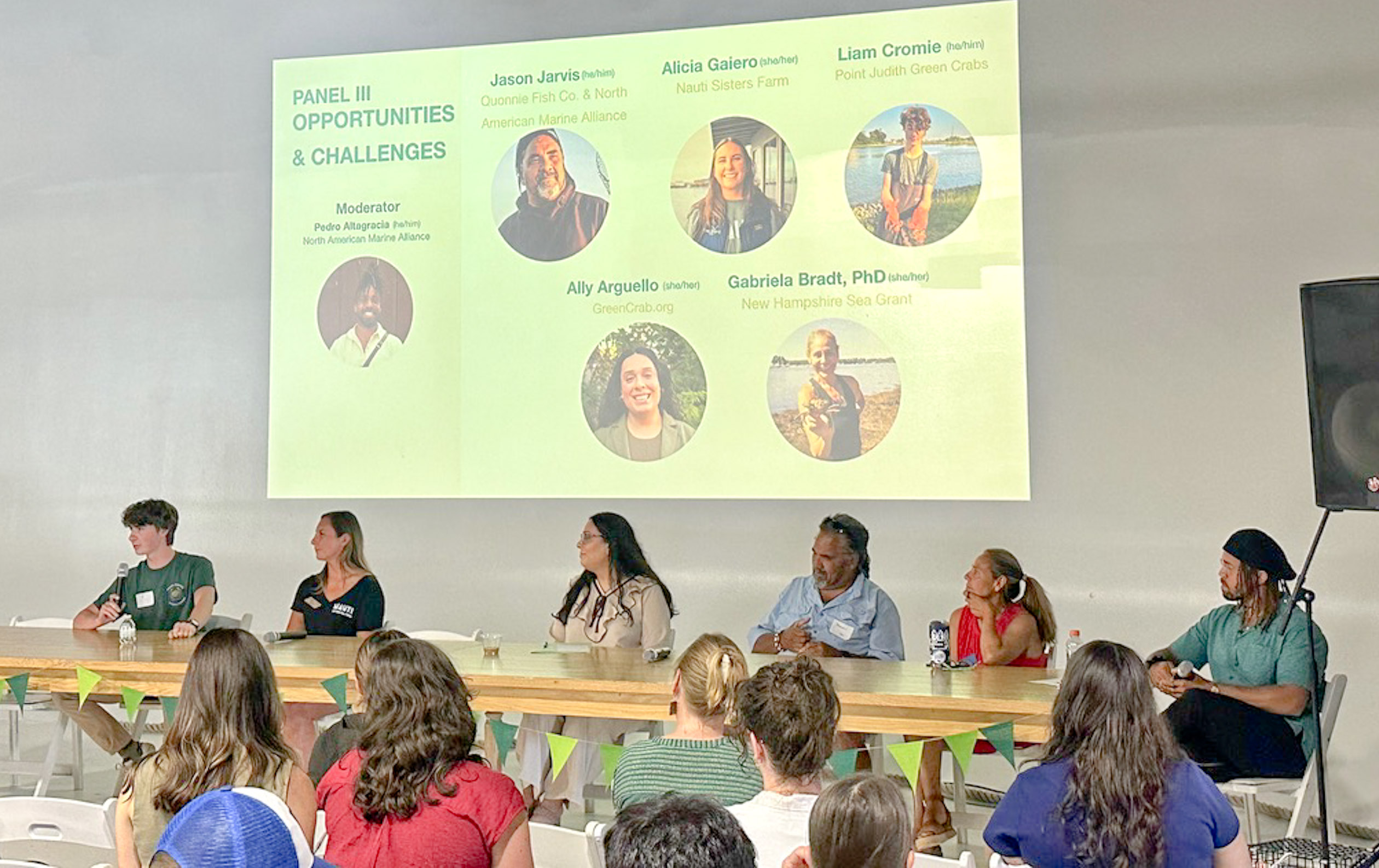
Top photo: Panel discussion filled with thought leaders: Liam Cromie, green crab harvester; Alicia Gaiero, Nauti Sisters Farm; Ally Arguello, GreenCrab.org; Jason Jarvis, Quonnie Fish Co.; Gabriela Bradt, NH Sea Grant; Pedro Altagracia, North American Marine Alliance. Photo: Kiran Johnson
