

Most of the work we do hinges on effective storytelling. Community engagement, education, advocacy, community building, blog writing, social media creation… All of this becomes alive, vibrant and relatable with good storytelling.
But it wasn’t until recently when I had the privilege of speaking to more than 20 ambassadors in training from around the world for Inland Ocean Coalition that I found myself telling stories about storytelling.
And I learned much from the experience.
The Opportunity
Inland Ocean Coalition (IOC) is a partner organization advocating for healthy waterways throughout our lands and into our oceans. What we do on land affects our inland waters as well as our estuaries, bays and oceans. IOC has a fabulous Ambassador Training Program to train values-aligned, passionate volunteers to speak up for ocean health, ultimately guiding them to become leaders for ocean advocacy.
On April 8, I spoke with the spring cohort, including folks from as far away as India, about the importance of good storytelling in engaging communities in ocean advocacy conversations and building awareness about why these conversations matter.
Who’s your audience?
One key element of effective message delivery is mapping the story to your audience. I provided examples of this dynamic from a series of classroom discussions I led over a couple of weeks in April. During that time, I spoke with about 160 7th graders at Lyman Moore Middle School in Portland, ME; about 25 Advanced Placement Environmental Sciences students at North Yarmouth Academy in Yarmouth, ME.; about 5 University of Massachusetts graduate students taking a Global Food Systems Course (via Zoom); and over 20 ambassadors in training for IOC (also via Zoom).
Naturally, the focus range of 7th graders versus graduate level students and professionals is seismic. Each conversation had its own story arc with some common threads about the importance of understanding our relationship to seafood (whether we eat it or not) and why we should care.
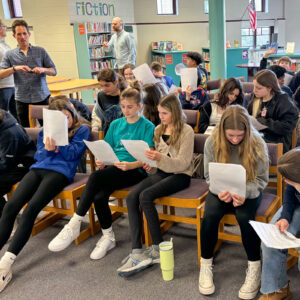
A group of 7th graders dives into the right whale/lobster issue during a class at Lyman Moore Middle School.
Tailor the message
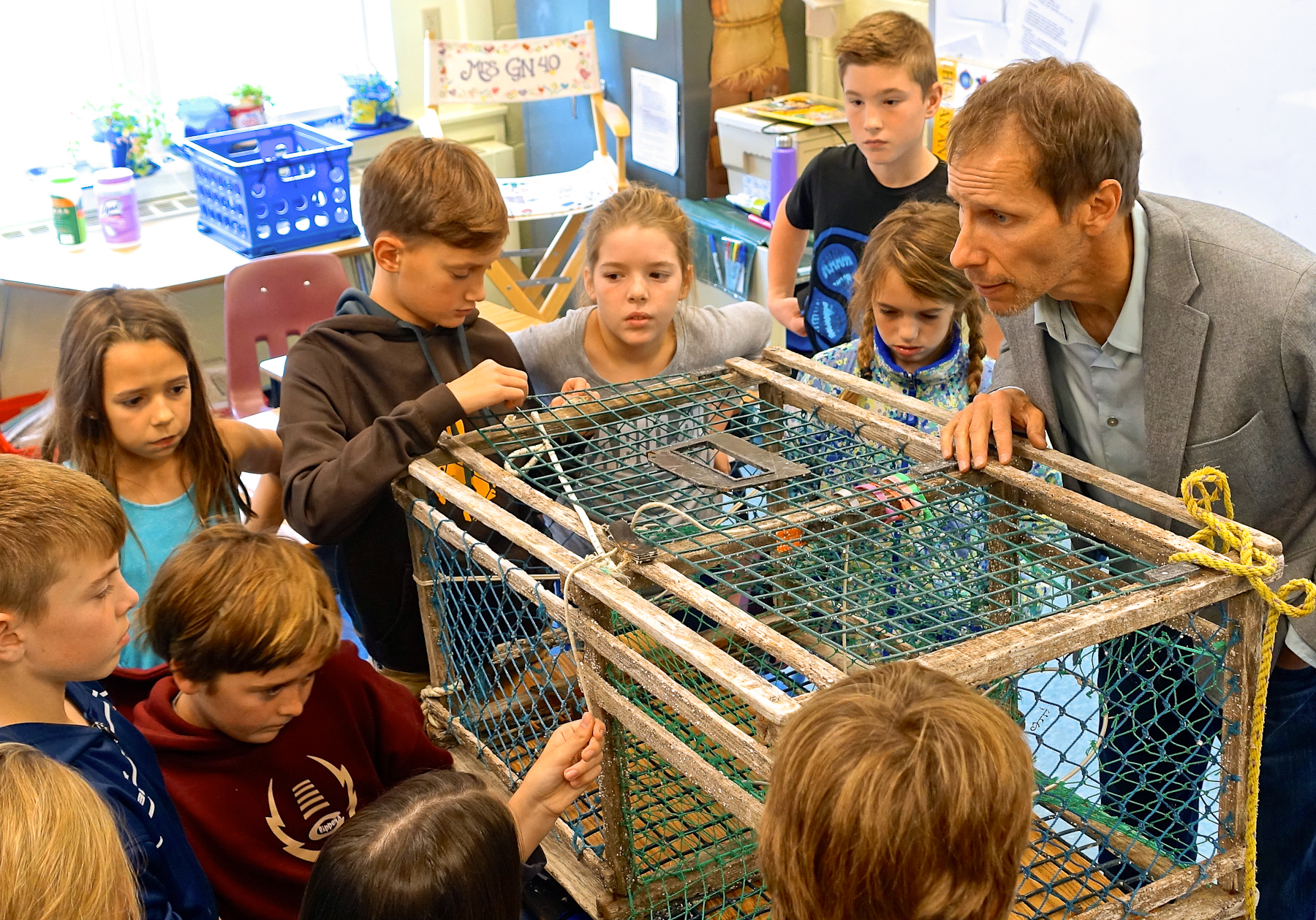
For the 7th graders, I provided a broad lens of what sustainable seafood looks like from One Fish Foundation’s perspective, then shared a specific example of how complex our relationship to seafood can be via the situation involving right whales and Maine lobstermen. I first shared some info about threats to endangered right whale populations and how some proposed measures to protect those whales could fundamentally shrink Maine’s iconic lobster industry, without any guarantee these measures will save right whales. Then I asked the students to break up into small groups and act as regulators to devise a solution that protects both right whales and Maine’s lobster industry. That exercise sparked good conversation.
For the AP Environmental Sciences students, we dove into the industrialization of the seafood supply chain, looking at things like aquaculture with values (bivalves and seaweed) vs. industrial finfish aquaculture. We talked about the ecological fallout from massive fish farming, including everything from chemical use and algal blooms to the rampant over-harvest of forage fish to feed farmed salmon and other species.
I guided the graduate students through the industrialization of the domestic and global seafood supply chains. We discussed examples of US fisheries policy that promotes industrialization and consolidation, including catch shares (which treat access to fisheries like Wall Street stocks and forces many generational fishermen out of business.)
I tailored the message, the science, and the key takeaways to each audience, with one overarching takeaway: Take ownership of your relationship to seafood by asking questions and getting to know the story of your seafood.
Melanie Brown fishes for wild sockeye salmon in Bristol Bay, AK. Her story about her Yupik heritage and learning to fish from her great grandfather captivated students in virtual classes during the pandemic.
Include experts
Where possible, bring in different perspectives to complement your story. I’ve had commercial fishermen from as far away as Alaska and Pennsylvania Zoom in to talk to my classes about the importance of protecting Bristol Bay, AK from the proposed Pebble Mine, for example. Those firsthand stories further engage students in why they should care about the message.
Ask questions
Bring individual members of your audience into the conversation by inviting folks to share their opinion on a specific topic. Ask them relevant questions about the topic. Doing so prompts engagement so they feel invested in the conversation.
Caring is sharing
Passion is everything. The most effective speakers are those who truly care about the topic at hand. They bring an energy to the conversation because it resonates so deeply. And that passion is infectious. It’s what often draws people in because they see how much you care.
Keep Learning
One thing I have learned is that each storytelling engagement is an opportunity to learn something new about the audience, the message and the delivery. I try to take something, even small, away from each classroom or community event I’ve visited.
It’s been nearly 11 years since launching One Fish Foundation, and I’m still learning the craft of effective storytelling about sustainable seafood. Witnessing very accomplished storytellers (like those on TedX or the Moth Radio Hour) has helped me improve my message delivery.
Continuing to hone that skill hopefully strengthens the One Fish mission of changing how we think about local seafood … one conversation at a time.
