

No one who produces local food in a system rigged toward corporations should have to stand alone. No one who supports those who produce local food in the face of industrialization should have to do this work alone.
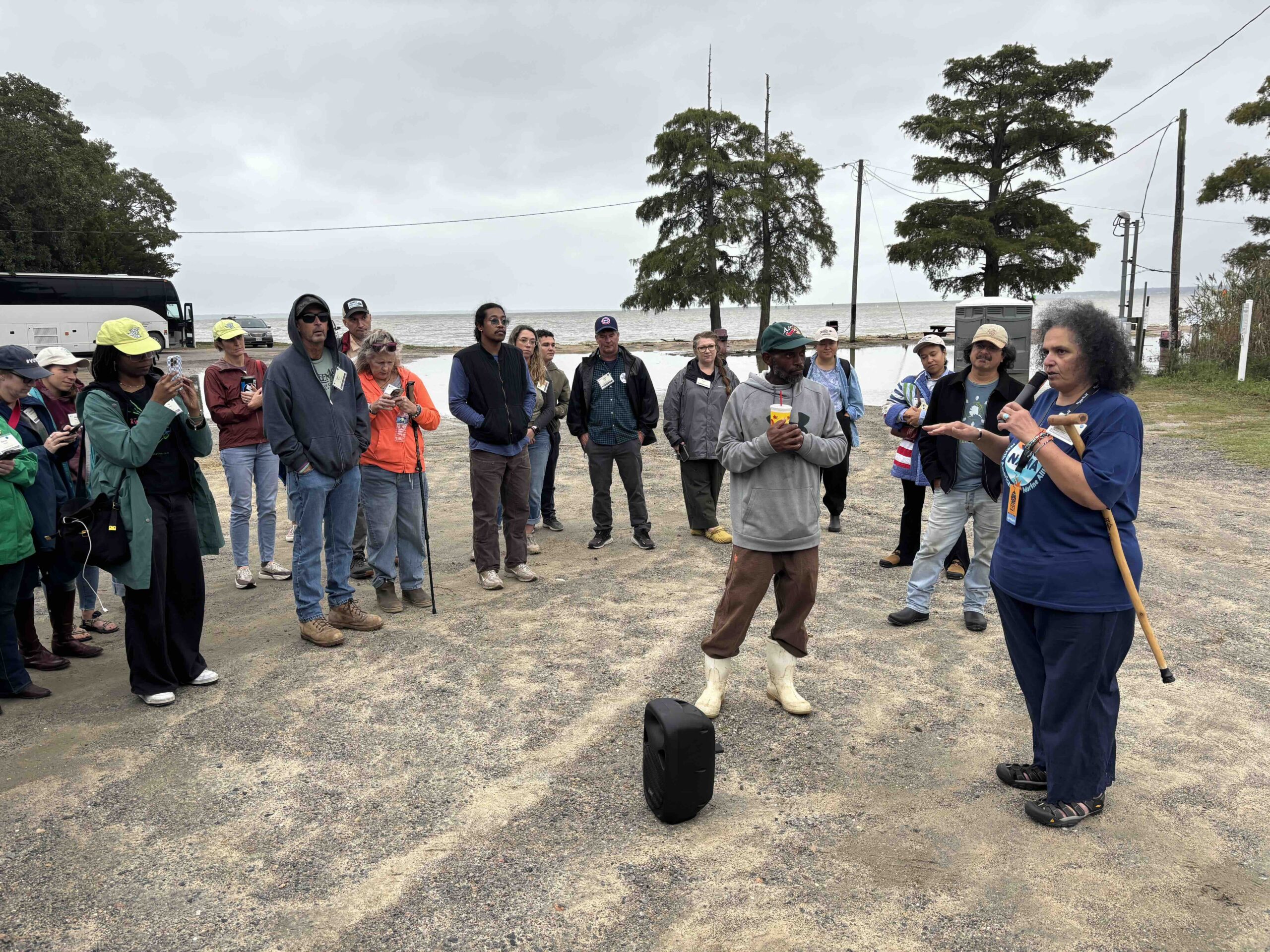
A very powerful moment during a tour of a once-vibrant black-owned fishing community in coastal Virginia just prior to Farm Aid brought striking clarity to the above statement.
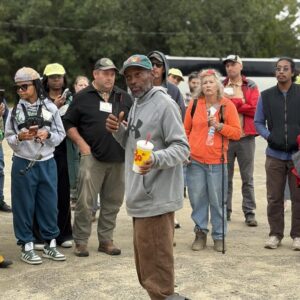
Johnnie Tynes, Jr. describes life as a black fisherman in a once thriving fishing community at Tyler’s Beach, Va. Photo: Mara Welton
Johnnie Tynes, Jr, a crabber from the historic community of Tylers Beach, Va., was jarringly honest about his situation. “The fish mafia is taking over. The struggle of a black fisherman in Virginia is real,” he said. “What I hope for is that we build something that the younger folks want to do too.”
He described how the little harbor once hummed with the engines of boats operated by black fishermen heading out to catch fish and shellfish for their communities and beyond. Now there are maybe three black fishermen actively working the waterways. He talked about the crippling loss he felt after someone stole about 300 crab traps from his lawn and the absolute fear he would not be able to keep doing what he loves.
And with disarming candor, he spoke about praying every morning to find a path forward. Then someone gave him nearly 300 traps that he could repair and use.
One day at a time. That’s how Johnnie faces the struggle.
Immediately after Johnnie finished his story, Niaz Dorry, Coordinating Director of North American Marine Alliance and one of my sheroes and mentors, walked up to Johnnie and effectively said that NAMA’s role, and that of many of the allies standing on that sacred ground listening to his story, was to have his back, and the backs of other seafood producers facing similar challenges.
The raw emotion and tears in her eyes drove the point home.
No one should have to do this work alone.
That moment also clarified another reality: You must have that kind of passion – where your empathy for those you’re standing up for is so strong you feel their struggle too – to have someone’s back doing this work. Why else stay in it? How else are you going to support those doing the hard work unless you have a good idea of what their struggles feel like?
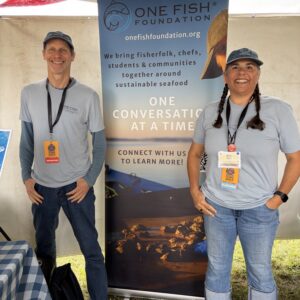 We carried that sense of urgency and passion for the work to Farm Aid on Sept. 26, when One Fish Foundation Operations Manager Mara Welton and I shared a table with friends and allies Mia Glover and Haley Stein of Inland Ocean Coalition.
On a cool, drizzly day, we set up a display table educating folks about the difference between those practicing aquaculture with values (ie, growing bivalves, kelp, etc. that are ecologically beneficial and that feed their communities), and industrial aquaculture like salmon and shrimp farming.
We pointed out folks in our collective network across the country on a map describing their location and what they farm.
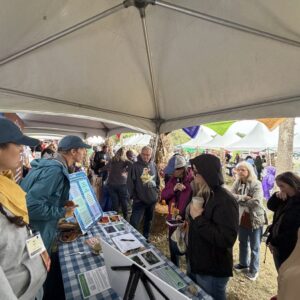
Mia Glover of Inland Ocean Coalition and Colles talk about aquaculture with values and what supporting local seafood means with visitors. Photo: Mara Welton.
We had a very cool silver fabric salmon with pipe cleaner sea lice for folks to learn more about how prevalent sea lice is in industrial finfish farming.
Folks had the opportunity to choose which of the oyster shells we displayed was farmed or wild harvested.
Folks also enthusiastically took our seafood IQ quiz, learning more about how we eat seafood in this country and why they should take ownership of their relationship to seafood. We challenged them to reframe how they think about seafood purchasing in the future. And we asked them to spread the word.
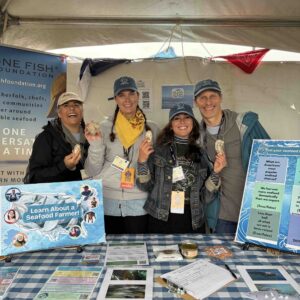
Before the gates opened, the crew got our seafood mojo on. L to R: Mara Welton, One Fish Foundation; Mia Glover, Inland Ocean Coalition; Haley Stein, Inland Ocean Coalition; and Colles. The aquaculture map is on the left, the quiz on the right. Photo: Feini Yin
For nearly five hours, we hosted intimate conversations with a couple hundred folks who stopped by. Most were genuinely interested in learning more, and committed to spreading the message within their own networks.
It was exhausting. It was stimulating. It was rewarding.
It was exactly what we signed up for. And hearing Johnnie’s story, Niaz’s response and more stories from others doing the work, was the fuel.
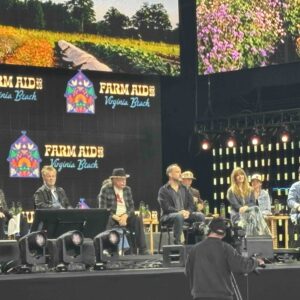
Farm Aid royalty and board of directors: Willie Nelson, John Mellencamp, Neil Young, Dave Mathews, Margo Price and Nathaniel Rateliff.
Later, as we danced and sang along with Willie, Neil, John, Dave Matthews, Nathaniel Rateliffe, Margo Price, etc., we celebrated the community we’ve built together, doing the hard work that hurts sometimes.
Top photo: Niaz Dorry of North American Marine Alliance lets Johnny Tynes, Jr. know that NAMA and other people and organizations witnessing his story have his back during the seafood tour on Sept. 24 heading toward Farm Aid that weekend.