

“The fishing communities are considered part of the ecological problem,” said Niaz Dorry, executive director of the North American Marine Alliance. She added, “there’s a difference between people who want to make a living from the ocean and those who want to make a killing from the ocean.”
At New York Climate Week on September 22 fisherfolk, aquafarmers, leaders and advocates gathered in a room in Manhattan for panel discussions about the future of the seafood industry, and effectively, the future of the ocean. The event was hosted by North American Marine Alliance and Resource Media.
On one side is the “blue revolution,” the global expansion of aquaculture and other investment-based “economic opportunities” in our oceans. In this model, boats and farms are consolidated into large companies in the name of efficiency and mass food production, regardless of the ecological and socio-economic impacts.
For example,, a 2022 investigation by ProPublica and The New Bedford Light found that companies linked to private equity firms and foreign investors, like Blue Harvest, have taken over much of New England’s’s ground fishing industry. Blue Harvest’s merciless hunt for haddock over a couple of years led to drastic population declines before the company filed for bankruptcy and left over $100 million in debt, forcing many fishermen to sell their boats and devastating many regional businesses. Talk about killing an industry.
Alternatively, many small to mid-scale fishermen and aquafarmers who come from generational fishing families are just making ends meet. They are feeding their communities, even as they face increasing economic, environmental and legal obstacles.
“Small to mid-scale fishermen actually have a calculated inefficiency built into their model, because that inefficiency is what helps them meet other values,” said Dorry, as she opened the conversation for the first panel.
These values might include strengthening and feeding a fishermen’s own community, paying fair wages and caring for the ocean while doing their job.
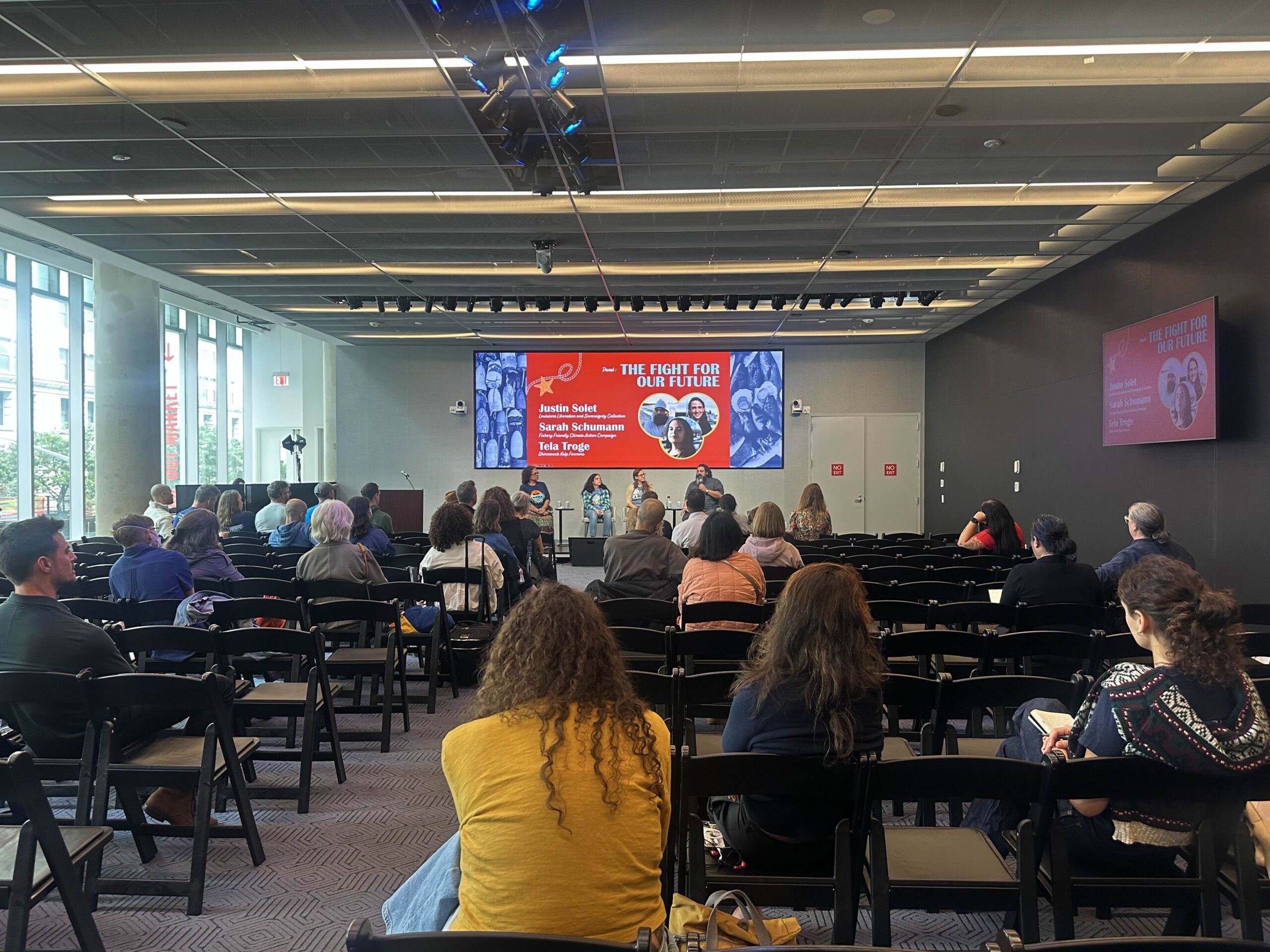
A panel discussion moderated by Niaz Dorry and featuring Tela Troge, Sarah Schumann and Justin Solet. Photo: Kiran Johnson
Rebuilding infrastructure
“The industrial food system puts so much pressure on small-scale fishing,” said Brett Tolley. He spoke at the event as the founder of Chatham Harvesters, a fishermen-owned seafood co-op based on Cape Cod, Massachusetts.
Small fishing operations, like those in Tolley’s community, are selling to a market shaped by larger players.
“Restaurants have the ability to purchase off of other big distributors, where the price points are just so much cheaper than buying directly from a boat,” he explained.
In 2018, Chatham was the third largest fishing port in Massachusetts, bringing in 25 million pounds of seafood annually. Dogfish is the highest volume catch, but most of it gets shipped to Europe. This points towards how community infrastructure is no longer designed to support local fishermen—and hasn’t been for a long time.
“My father was a fisherman,” Tolley said.
He remembers, as a kid, people would ask where they could buy his father’s fish. But noone on Cape Cod sold his catch. Instead of following in his father’s footsteps, Tolley embarked on a career advocating for fishermen like his father, leading much of the community organizing for NAMA before cofounding Chatham Harvesters. The coop’s mission is to give control over pricing back to fishermen, ensuring fair pay for their work. He remembers the first fish the co-op sold.
“It was something so simple. We caught a fish, we cut it, packed it, and we’re selling it in our own community, but it took us two years of massive investment, time, all these permitting processes,” said Tolley. “And no one had done that in our community for probably 30 years.”
Now, the cooperative sells fish at five farmers’ markets, up to 15 restaurants, five grocery stores and various local seafood buyers. Their main business model, though, relies on a direct connection to consumers through a membership. Much like community supported agriculture where folks pay upfront for a share of the upcoming harvest, Chatham Harvesters customers pay at the beginning of the season to receive fish. This community supported fishery (CSF) model directs the pre-payment toward fishermen’s upfront costs, like fuel, wages, insurance, gear and bait.
In its first year, in 2016, the cooperative had 250 people join as members, providing $25,000 in advance of the season. Last year, they had 1200 members, resulting in $70,000 upfront payments. This year, Chatham Harvesters is projected to reach 2000 members.
“That pre-payment in advance of the season allows us to not have to go to a bank or take out loans,” said Tolley.
In his experience, traditional lenders and investors generally won’t take a risk on a business like Tolley’s. They want fast growth and high returns, which pushes companies toward being bought out by a bigger player so investors can cash in. That model rarely leaves room for a business to “place priority and emphasis on things that are not just about the profit,” he said.
The co-op looks to its customers instead, who are in effect its investors. This model enables Chatham Harvesters to support its community and local ecosystem through sustainably harvesting fresh and nutritious fish.
Investing in the future
“Do you think any bank is going to invest in me for 60 years? No, they want to make a one-year investment, maybe two,” said Tela Troge, who is a member of the Shinnecock Nation and an attorney and kelp farmer. She has a 60-year plan for the work she’s doing to improve food systems.
In 2019, she and a group of five intergenerational, Shinnecock women started Shinnecock Kelp Farmers on the East End of Long Island, New York. It is the first indigenous-owned seaweed farm on the East Coast.
“Traditionally, communities like ours have been denied access from capital,” she said. No one in her community has post office addresses, which means they also don’t have bank accounts because of stipulations under the Patriot Act, she said,Shinnecock Nation residents own their land collectively, which means they also can’t get mortgages or home equity loans.
Shinnecock Kelp Farmers has found that multi-year, unrestricted philanthropy funding best suits their business, enabling them to invest in their future.
Launching the farm was a response to the question, “How are we going to feed the next seven generations?”
When it comes to the current generation, Troge’s four-year old, the oldest of three, wants to eat fish. “He wants to go out and catch the fish himself,” said Troge. “What am I supposed to tell him?”
In her son’s lifetime, they haven’t been able to fish in the bay due to dead zones caused by nutrient pollution. In her own childhood, Troge played in the bay’s waters which were full of horseshoe crabs, clams and oysters. These marine species all disappeared by the time she reached middle school, replaced by red and brown tides.
When COVID-19 hit in 2020, wealthy citizens moved from Manhattan to the east end of Long Island, including Shinnecock Hills. The chemical fertilizers from their expansive lawns leaked nitrogen into the bay and expanded septic systems sullied waterways. Grocery store prices rose to the point where Troge’s community couldn’t afford to buy food at nearby supermarkets.
“My grandfather told us we never needed money, because all we had to do was walk out to the bay and we could get food,” she said.
To revive that reality, the farm’s lines of sugar kelp were planted around Shinnecock land to remove excess nitrogen, phosphorus and carbon dioxide from the water.
The impact has been beautiful, according to Troge. She has seen sharks, shorebirds that hadn’t been present for 20 years due to a lack of fish to eat, and the return of the Peconic Bay scallop, which scientists had declared near-extinct.
For Troge and her community, harvesting seaweed is also a way to assert tribal sovereignty over the water in a state where the Department of Environment Conservation is notorious for harassing tribal members who go out fishing. The Shinnecock Nation has had a relationship with kelp in the bay for the past 10,000 years.
“We can all go get degrees in regenerative agriculture or we can ask the locals and look into nature-based solutions,” said Troge.
A new climate constituency
“We also can be leaders of climate mitigation,” Sarah Schumann said. She is a commercial fisherman and the founder of the Fishery Friendly Climate Action Campaign.
Schumann works between coasts in Rhode Island and Alaska to bring the fishery community to the forefront of climate advocacy and push for fishery-friendly climate solutions.
“Fishermen are directly impacted by fossil fuel pollution,” she said. Rapidly acidifying oceans, increasing ocean temperatures, multiplying major storms, expanding coastal erosion and other impacts affect how and when fishermen and seafood farmers can harvest. These effects change species’ distributions that end in mismanagement of fisheries and stock crashes resulting in fishery closures. Sadly, fishermen are rarely involved in conversations about policy changes and potential solutions.
Part of closing that gap is changing the narrative by “raising awareness of the fishing community as a climate constituency—not just a constituency that is victimized by climate, but a constituency that is resourceful and is thinking about solutions,” she said.
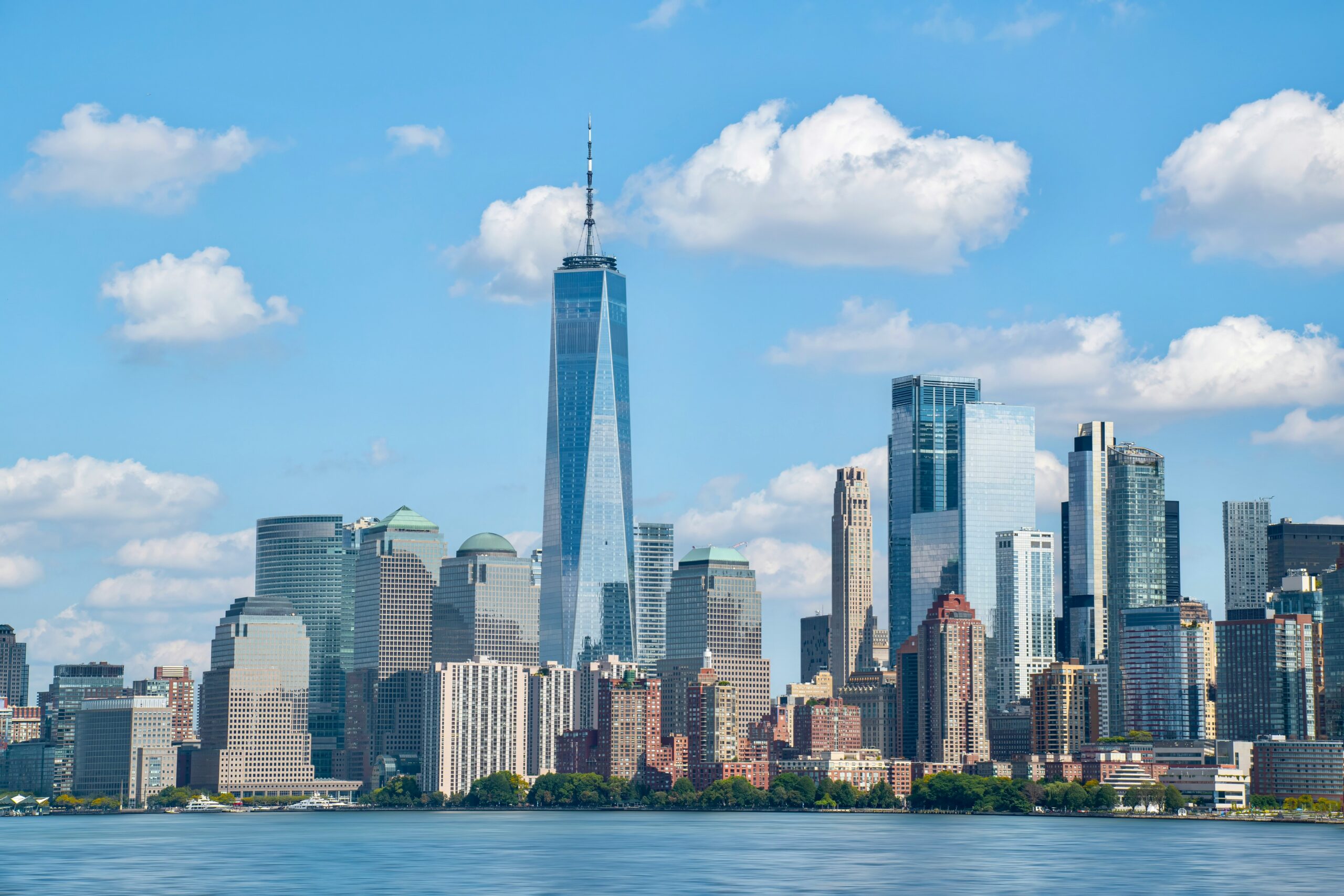
Top photo: A view from Liberty Island with the Financial District of Manhattan Island in the background, New York City. Photo: Massimiliano Morosinotto